A letter to the international community: Stop the concentration zone in Gaza
About 40 Bosnian civil society organizations, groups and initiatives, as well as prominent human rights activists and other individuals, signed a letter condemning plans to build a “concentration zone” for hundreds of thousands Palestinians in Gaza, urging the international community to act before it’s too late.
The letter has been sent to representatives of several governments, as well as international bodies and institutions such as the United Nations, European Commission, European Parliament, Council of Europe, OSCE, International Criminal Court, International Court of Justice and others.
You can read the text of the letter below.
This week marks thirty years since the fall of the Srebrenica safe area. On July 11, 1995, Ratko Mladić’s soldiers entered the enclave and, in the presence of UN troops, committed crimes classified as genocide by international and domestic courts. Tens of thousands of people are expected at the Memorial Center Potočari this Friday, for yet another funeral and commemoration of the victims of genocide.
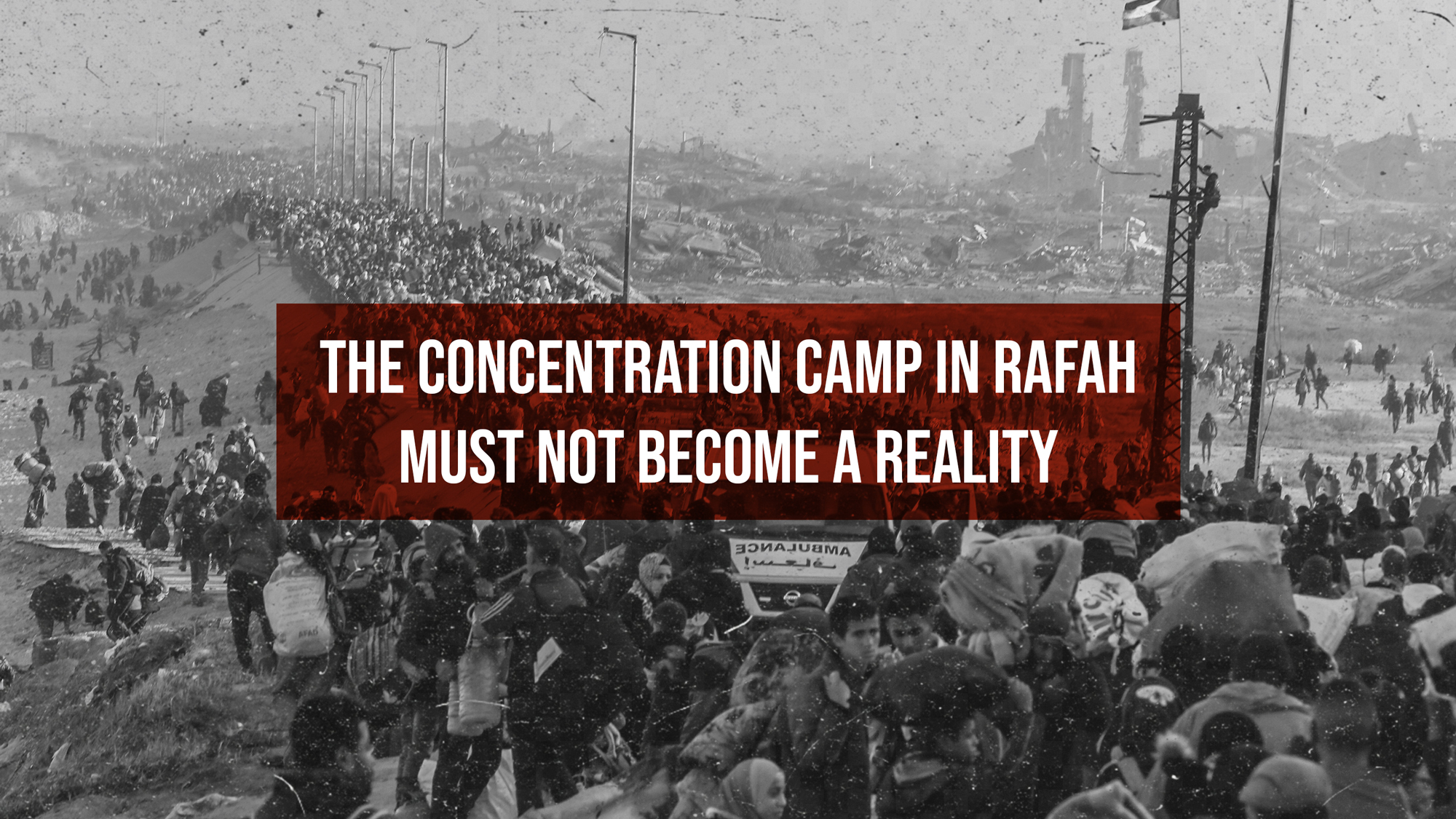
While preparations are underway in our part of the world to mark this anniversary, in another part of the world plans are being made to establish a similar “safe area” for hundreds of thousands of people. This week, Israeli Defense Minister Israel Katz stated that he had ordered his units to begin preparations for establishing a “humanitarian city” on the ruins of Rafah, in the southern Gaza Strip. This “city” is meant to confine hundreds of thousands of Palestinians in Gaza. They will not be able to leave unless they apply for relocation to a third country willing to accept them. Provided that they even survive such a “city.”
More than 55,000 people have been killed in Gaza since October 2023, when the conflict between Israel and Hamas escalated. They were killed in relentless bombings throughout the Gaza Strip, but also in attacks on hospitals, refugee camps, and schools where displaced people had sought shelter. They were also killed while trying to collect humanitarian aid distributed by the Gaza Humanitarian Foundation (GHF), an agency established by Israel and the United States after a complete blockade of humanitarian aid entry into Gaza, despite protests and criticism received from international organizations and humanitarian initiatives whose work in Gaza was stopped months earlier. According to a United Nations report, in just the first month of GHF operations, the Israeli army killed over 400 Palestinians trying to reach food at these checkpoints. In the past month, the number of victims has risen to over 700. Israeli Prime Minister Benjamin Netanyahu announced the establishment of this agency in May this year, along with a “sterile zone” free of Hamas in the southern Gaza Strip. Now there are talks that the GHF will be in charge of aid in the “humanitarian city” built on top of the remains of Rafah, along with other unnamed international organizations.
Human rights and international law experts warn that this is a plan for new crimes against humanity in Gaza. Such a camp is nothing more than an internment center for the expulsion of survivors and the ethnic cleansing of Gaza. These are war crimes, similar to what Bosnians and Herzegovinians endured thirty years ago, crimes we hoped never to see again, especially not with the silence or even support of democratic countries that take pride in protecting human rights and the rule of law.
Israeli authorities have not been particularly shy about their intentions to ethnically cleanse Gaza and expand Israeli settlements there. Their most significant partner, U.S. President Donald Trump, was also not opposed to such ideas. These days, he is optimistic about peace talks between Israel and Hamas. Trump and Netanyahu discussed a 60-day ceasefire this week, and this period is precisely when the “humanitarian city” – a concentration zone for Palestinians in Gaza – is expected to be established.
There is no doubt that this is a preparation for the expulsion of Palestinian children, women and men from Gaza. A city is a place of life, with hospitals, schools, shops, cinemas, and theaters, a place where people LIVE and move freely. A “humanitarian city” in Rafah would be a place of confinement, without any of the things that make a dignified life, a place without a future, where only death and exile are certain. There is no such thing as “voluntary relocation” from such a place.
Such a concentration camp must not be built and can not be a part of any peace plan or negotiations. The international community must not allow it to happen. If this crime against humanity in the making is also met with silence or approval, as previous crimes in Gaza have been, it will be yet another, perhaps fatal, blow to international law and justice, already deeply wounded in Palestine and stripped of nearly all meaning and gravitas.
Thirty years ago, the world watched concentration camps, massacres, and ethnic cleansing in Bosnia and Herzegovina unfold on the evening news, up to the point when genocide in Srebrenica was committed. Since then, we have heard “never again” countless times: ”never again” Srebrenica, “never again” Prijedor, “never again” Sarajevo, “never again”… The genocide in Srebrenica was committed in Europe, in the presence of the international community and before the eyes of the whole world. To believe that what we already witnessed will not be repeated in Rafah is naïve.
The plan for a “humanitarian city” in the southern Gaza Strip, for hundreds of thousands of people already living in utterly inhumane conditions, has to be the final wake-up call for the world’s conscience. For nearly two years, states and international organizations have tolerated numerous violations of human rights and the laws of war and have failed to impose sanctions against Israeli authorities who are killing and starving Palestinian children, women and men and now plan to get rid of the survivors.
We call on the United Nations Security Council to adopt a resolution on an arms embargo against Israel, given the serious violations of international humanitarian law, and to establish an international investigative commission to document potential war crimes and crimes against humanity in Gaza. We also call on UN member states to employ other coercive measures, such as breaking or limiting diplomatic ties and imposing unilateral sanctions, including freezing the assets of Israeli officials and institutions, travel bans, and the termination of trade agreements. Similar to the sanctions imposed on Russia after it invaded Ukraine, Israeli banks should be excluded from the SWIFT system, and companies cooperating with Israel should face the threat of sanctions.
Effective, targeted, and legally grounded sanctions against Israel are necessary not only to stop the killing and displacement but also to prevent the long-term institutionalization of apartheid and impunity. Sanctions must compel Israeli authorities to respect international law, enable unhindered humanitarian aid, and end the policy of collective punishment of the civilian population.
Thirty years ago, the international community did not prevent the genocide in Srebrenica. Today, there is still time to stop one in Gaza.
Signatories:
Organizations / groups:
Bh. povorka ponosa / BiH pride march
Centar za mlade KVART Prijedor
Centar za postkonfliktna istraživanja / Post – Conflict Research Center
Centar za promociju civilnog društva (CPCD)
Centar za zastupanje građanskih interesa – Fondacija CPI
DKC Sarajevo
Fondacija Atelje za društvene promjene – ACT
Fondacija Boris Divković
Fondacija Infohouse
Fondacija za razvoj medija i civilnog društva “Mediacentar”
Kvinna till Kvinna, BiH
Sarajevski otvoreni centar
Sve su to vještice
Tuzlanski otvoreni centar
Udruženje/udruga BH Novinari
Udruženje građana i građanki Zašto ne
Udruženje građana Oštra Nula
Udruženje za kulturu i umjetnost Crvena
Udruženje žena “Napravi Razliku”
Udruženje “Sara-Srebrenica”
Individuals:
Alma Gačanin
Andreja Dugandžić
Azra Berbić
Belma Bećirbašić
Bojana Kostić
Borka Rudić
Dajana Bakić
Dajana Cvjetković
Dženana Alađuz
Edin Ibrahimefendić
Feđa Kulenović
Hana Ćurak
Jasmina Čekrić
Lejla Huremović
Lejla Kusturica
Maida Muminovic
Maida Zagorac
Milica Pralica
Nedžada Avdić
Tamara Miščević
Valentina Gagić
Vildana Džekman
Signatures of Support:
Amra Kapetanović
Minja Damjanovic
Dalio Sijah
Ivana Vučetić
Azra Hodžić-Čavkić
Dino Kasumovic
Biljana Livancic
Adna Sokolović
Emir Nazzif Fetahovic
Samra Skokic
Lamija Haračić
Selma Raonić
Emina Bošnjak
Sanela Cesko
Amina Čeliković
Azemina Hujdur
Admir Adilović
Elma Dulić
Arnela Trešnjo
Lejla Džanić
Senka Kurt
Muamera Cesko
Amina Vejzalajbegovic
Nerma Daut-Bajramovic
Dženana Kereš
Tarik Moćević
Sumka Bučan
Melika Šarić
Erna Dogic
Aldina Lipovac-Jandrić, Abrasmedia.info
Nev Trakic
Nesha Druškić
Murisa Polimac
Amina Kapur
Belma Buljina
Mersiha Besirovic
Lea Petrović
Lamija Tanović
Emina Kujundzic
Amra Erdić
Mehmed Haračić
Zaim Babic
Nirvana Kisic
Edo Kanlić
Aldijana Zorlak
Hana Bajrović
Vanja Šunjić
Senada Čačković
Binela Pipo
Alma Mečević
Irma Subašić
Fatima Redžović
Ilma Suljagic
Vedrana Faladžić
Belma Rizvanovic
Bosna River’s Watch 099 service
Selma Morankic-Miljkovic
Amila Šertović
Belma Mujazinović
ĐORĐE ILIĆ
Nina Imamović
JU Prva gimnazija Sarajevo
Minel Abaz
Almin Redžić
Elma Redžić
Ozrenka Mešić
Nahida Skopljak
Sanela Bašić, Univerzitet u Sarajevu
Nefisa Omerkic
Emina Cengic
Elma Agić
Belma Čutura
Delila Hasanbegović Vukas
Selma Demirović
Selma Terzic
Anesa Slinić
Ernada Avdibegovic
Lejla Abdel Rahman Colic
Ajna Katica
Amar Karađuz
Alisa Brkić
Danina Vranic
Amina Šatrović-Barišić
Ilma Čosić
Deni Sijah
Sabina Jušić
Amela Haračić
Jelena Kalinic
Amina Izmirlić Ćatović
Amra Lemeš
Centar za edukaciju i istraživanje “Nahla”
My Right – Empowers people with disabilities
Nataša Maros
Sanja Majić
Aida Karović
Hata Kujrakovic
Lamija Vehabović Halilović
Tarik Jahic
Amela Šoljić
Nela Milosevic Ilic
Sabina Besirevic-Zahirovic
Nela Milosevic Ilic
Hatidza Hadzimuhamedovic
Amina Dučanović
Edina Dogdibegović
Za čist zrak
Zina Drnda-Pašić
Ena Forto
Mirna Ler
Dženana Haračić
Lejla Mahmutcehajic Dizdarevic
Hajra Imširović
Belma Tirović
Mirna Ler
Amra Fočo
Betina Hačam
Džanita Kamerić
Naida Kucukalic
Elvir Đuliman
Selma Spahić
Haris Čebirić
Danira Karović Lačević
Aida Bičakčić
Željana Spasojević
Tanja Ristić
Lejla Mujakić
Lejla Zola
Merlinkina djeca
Alex Buza
Meliha Kadic
Hamza Fazlić
Udruženje za psiho-socijalnu podršku i bolju budućnost “Progres”
Azra Frlj
Amila Madžak
Izabela Marković
Matej Velić
Aida Krstić
Ermin Bašaškić
Majed Abu Kharroub
Jadranka Anic