UG “Zašto ne” at the Civil Society & Think Tank Forum 2026 in Prishtina
UG “Zašto ne” representatives Darko Brkan and Maida Ćulahović participated in the Civil Society & Think Tank Forum (CSF) 2026, held from 5 to 7 October in Prishtina as part of the Berlin Process. Together with the Centre for Democratic Transition (CDT) from Montenegro, UG “Zašto ne” led the Thematic Working Group on Digital Transformation, Artificial Intelligence and Digital Sovereignty, which developed recommendations for advancing digital policies in the Western Balkans through regional consultations.
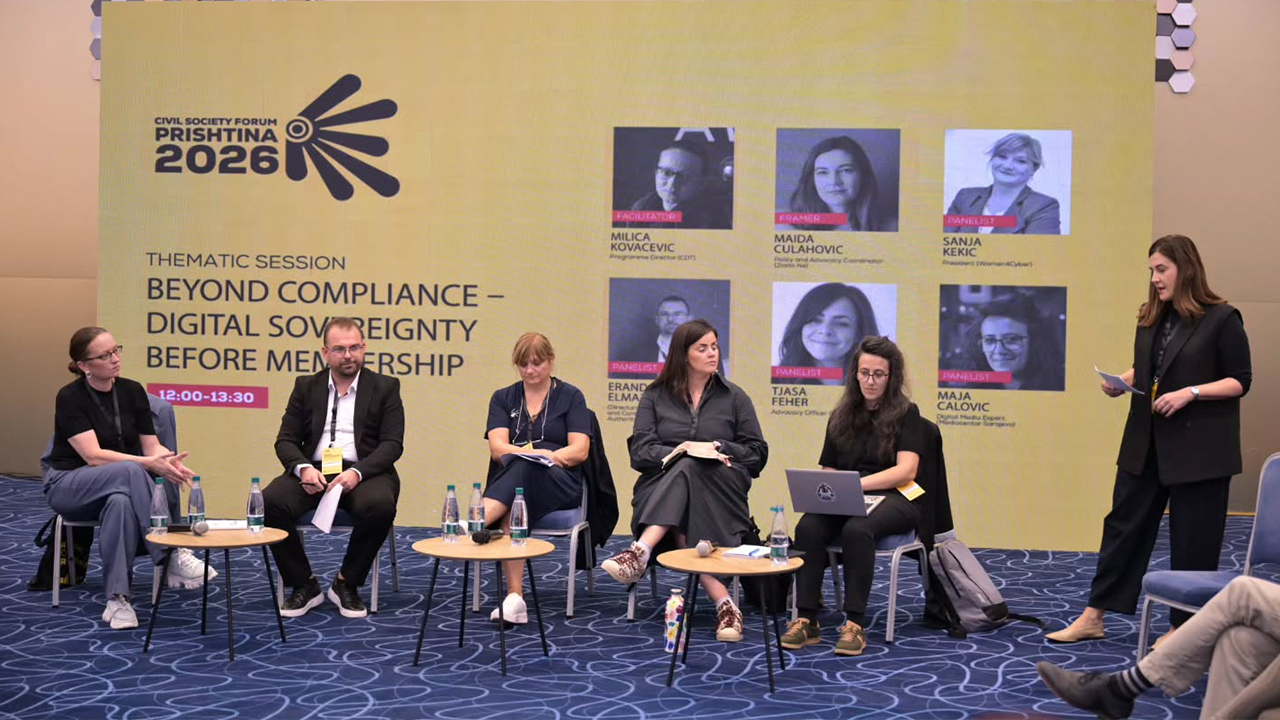 Photo: OSF Western Balkans/Instagram
The Civil Society & Think Tank Forum is the official civil society platform of the Berlin Process, bringing together civil society organisations and think tanks from across the Western Balkans to jointly develop recommendations for strengthening regional cooperation and advancing European integration. This year’s Forum brought together representatives of civil society, European institutions, and other international and regional organisations, with discussions organised across six thematic working groups.
From Alignment with European Rules to Effective Implementation
On 6 October, UG “Zašto ne”, together with CDT, led the session “Beyond Compliance – Digital Sovereignty before Membership”.
The session was moderated by Milica Kovačević, Programme Director at CDT, while Maida Ćulahović, Policy and Advocacy Coordinator at UG “Zašto ne”, delivered the introductory remarks. Speakers included Sanja Kekić from Women4Cyber, Erand Elmazi from the National Cyber Security Authority of Albania, Tjaša Feher from CRTA EU, and Maja Ćalović, a digital media expert from Mediacentar Sarajevo.
The discussion focused on key challenges faced by the Western Balkans in its digital transformation: moving beyond formal alignment with European rules towards their effective implementation; matching digital ambitions with institutional capacities while safeguarding rights and democratic processes; and ensuring that countries in the region can participate more actively in European digital governance even before EU accession. The role of civil society in shaping digital policies, monitoring their implementation, and ensuring democratic accountability was also a key part of the discussion.
“We have no shortage of ambition when it comes to the digital future of the Western Balkans. The real challenge is turning those ambitions into tangible results, backed by the institutions, capacities and political will needed to deliver them. The key question is who will take responsibility for delivering on these commitments and how we can ensure they do not remain merely on paper,” Maida Ćulahović emphasised.
Shared Regional Priorities and Recommendations
The work of the Thematic Working Group on Digital Transformation, Artificial Intelligence and Digital Sovereignty resulted in a set of regional recommendations published as part of CSF 2026.
The recommendations call for a strategic approach to digital governance, stronger regulatory and institutional capacities, responsible AI governance, protection of democratic processes, and the establishment of structured mechanisms for regional cooperation. They also advocate for more active participation of Western Balkan countries in European initiatives aimed at strengthening democratic resilience, particularly the European Democracy Shield, alongside stronger EU support for capacity building and the implementation of reforms across the region.
The recommendations of the Thematic Working Group on Digital Transformation, Artificial Intelligence and Digital Sovereignty are available here.
The recommendations of all CSF 2026 thematic working groups are available here.
The Civil Society & Think Tank Forum 2026 was organised by Open Society Foundations – Western Balkans, in partnership with the Government of Kosovo and in cooperation with the Government of Montenegro.
(Zašto ne)