Workshop on Digital Platforms and Online Media Governance in Bosnia and Herzegovina Between Regulation, Responsibility and Dependence
Bosnia and Herzegovina’s digital media space remains highly vulnerable to disinformation, hate speech, and structural weaknesses, while at the same time increasingly dependent on global digital platforms that shape how information is distributed and consumed.
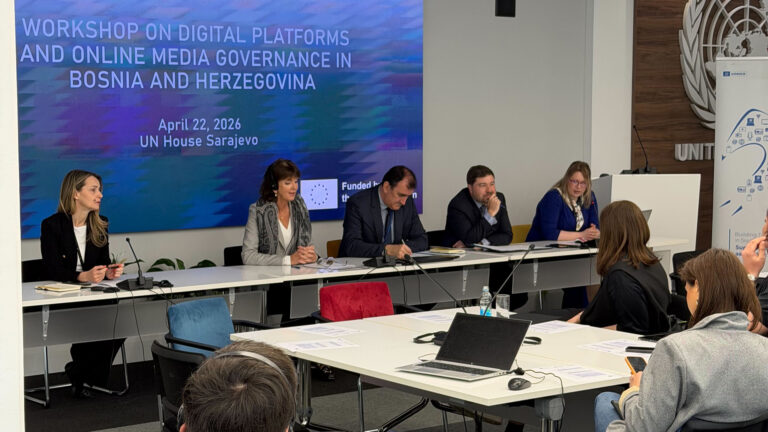
Photo: Zašto ne
These were among the key messages from the Workshop on Digital Platforms and Online Media Governance in Bosnia and Herzegovina, held on 22 April 2026 in Sarajevo, which gathered representatives of institutions, international organizations, academia, and civil society.
Opening the discussion, UN Resident Coordinator Arnhild Spence highlighted that the information space is becoming more fragmented and vulnerable to manipulation, stressing the dual challenge of tackling disinformation and hate speech while safeguarding investigative journalism. She particularly underlined the persistence of historically driven narratives in Bosnia and Herzegovina, as well as the disproportionate exposure of women to online harassment.
Advisor at the Ministry of Communications, Stela Vasić, emphasized that online media has become the primary source of information for citizens, making transparency, accountability, and reliability essential. She noted that Bosnia and Herzegovina continues to show low alignment with EU regulatory frameworks and stressed that media freedom and regulation should be seen as complementary, not conflicting goals.
Head of the UNESCO Office in Sarajevo, Siniša Šešum, pointed to a fragmented and insufficient legal framework, warning of broader risks related to censorship. He highlighted a key finding: 57% of media portals in Bosnia and Herzegovina have only partial or no impressum, revealing serious transparency and accountability gaps in the media landscape.
Echoing the need for stronger alignment with European standards, Ferdinand Koenig from the EU Delegation to BiH warned that digital platforms can be misused to undermine democratic processes. He emphasized that frameworks such as the Digital Services Act and the European Media Freedom Act should serve as guidance, but that real progress depends on genuine engagement by institutions and stakeholders.
Media Dependence on Platforms and Limited Capacity: Annex on Bosnia and Herzegovina findings
Presenting the annex of the study and related recommendations on regulation of social media platforms and online media in BiH, Amer Džihana from the Centre for Media and Policy Analysis highlighted that, despite the existence of a regulatory framework, media in Bosnia and Herzegovina face significant practical challenges in the digital environment.
Media, particularly smaller and local outlets, are heavily dependent on large platforms as their primary distribution channels, yet lack clear strategies, sufficient resources, and adequate understanding of platform algorithms. Constant changes, declining organic reach, and limited monetization opportunities further complicate their position, while weak moderation capacities leave media spaces exposed to harmful content. A particularly critical issue identified is the lack of effective communication between media and digital platforms, despite the platforms’ significant influence.
As emphasized in the discussion, media operate within systems they do not fully understand and over which they have little control, with limited institutional support. This imbalance directly affects content quality, media pluralism, and public interest.

Photo: Zašto ne
Reflecting on the process, Maida Ćulahović, Media and digital policy expert from “Zašto ne”, noted that, although limited progress has been made since the previous discussions, there is now a clearer understanding of regulatory expectations, particularly in relation to the Digital Services Act. She explained that the recommendations emerging from the process can be broadly grouped into regulatory measures, issues of media sustainability and visibility, and soft-law approaches that can be implemented immediately.
From Recommendations to Action: Shared Responsibility for a Resilient Media Space
The final session focused on reviewing and refining each recommendation, resulting in a consolidated version developed through joint efforts to present and identify the specific challenges participants encountered while working in groups. The discussions confirmed that Bosnia and Herzegovina’s media system is at a critical point, marked by high dependence on digital platforms, weak transparency, and limited regulatory alignment.
Moving forward will require more than formal reforms. As emphasized by participants, progress depends on coordinated action among institutions, media, civil society, and international partners, as well as stronger accountability and transparency across the system.
Only through such a comprehensive approach, combined with the consistent implementation of jointly developed recommendations, can Bosnia and Herzegovina move toward a more inclusive, transparent, and accountable digital environment, one that safeguards media freedom and democratic participation while addressing harmful content through legitimate means.